
Summary
Academic conference interpreting allows researchers, lecturers, and international attendees to participate in scientific conferences and research symposiums across language barriers. Simultaneous interpreting works well for keynote presentations and large sessions, while consecutive interpreting is useful for smaller discussions and interviews. Successful events require professional interpreters familiar with academic terminology, advance access to research materials, and appropriate interpretation equipment for in-person, virtual, or hybrid participation.
Organizing an international academic conference? Atlas Language Services provides conference interpretation services to support multilingual presentations, research discussions, and academic events. Contact our team to discuss interpreter requirements and equipment for your conference.
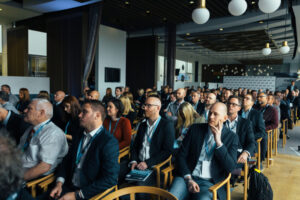 An international research symposium may bring together scientists, university faculty, graduate students, and industry professionals from several countries. Although English is often used as a shared language in academic settings, not every participant has the same level of proficiency or confidence when discussing technical research.
This becomes particularly challenging when speakers present unfamiliar terminology, describe experimental methods, or respond to detailed questions from the audience. Even participants who regularly read academic publications in a foreign language may struggle to follow a fast-paced discussion.
Academic conference interpreting helps address these challenges by allowing attendees to receive spoken information in languages they understand. With proper planning, conference organizers can support international participation while preserving the accuracy and intent of technical presentations.
What Is Academic Conference Interpreting?
Academic conference interpreting is the professional interpretation of spoken or signed communication during scholarly conferences, scientific meetings, research symposiums, and university events. A conference interpreter communicates a speaker’s message in another language while maintaining its meaning, technical terminology, and context.
Unlike written translation, interpreting takes place as communication happens. The interpreter must understand the speaker’s message and communicate it without the extended revision process available to a translator.
Academic interpreting may be needed at events such as:
- International research conferences: Presentations involving scientific discoveries, experimental findings, and ongoing research projects.
- University symposiums: Events where faculty, graduate researchers, and visiting lecturers present scholarly work.
- Scientific and technical workshops: Smaller sessions involving specialized terminology, demonstrations, and discussions.
- International academic partnerships: Meetings between universities, research centers, and institutions collaborating across borders.
- Research policy conferences: Events involving government agencies, non-governmental organization’s, and international institutions discussing research funding or scientific policy.
An important distinction is that academic conference interpreting refers to language support at academic events, not training programs for interpreting students. Although universities offer degree programs in interpreting studies and translation studies, event organizers generally need practicing professional interpreters with relevant subject-matter knowledge.
Simultaneous vs. Consecutive Interpreting for Academic Events
The two primary methods used during academic conferences are simultaneous and consecutive interpreting. Each has advantages depending on the conference program, audience size, and communication format.
Simultaneous Interpreting for Keynotes and Research Presentations
Simultaneous interpreting allows an interpreter to communicate the speaker’s message in another language with only a short delay. The speaker continues presenting while attendees listen through headsets or designated digital language channels.
This method is well suited to keynote speeches, plenary sessions, and international conferences with tightly scheduled presentations. Researchers can present their findings without stopping after every sentence, allowing organizers to preserve the conference timetable.
For example, a European university hosting an international climate science symposium might have researchers presenting in English, French, and German. Simultaneous interpreting can allow participants to select the language they need while keeping the presentations on schedule.
Professional conference interpreters commonly work in teams, alternating during demanding simultaneous assignments. According to the International Association of Conference Interpreters (AIIC), simultaneous conference presentations generally require two or three interpreters per active target language, depending on the assignment.
Consecutive Interpreting for Smaller Academic Discussions
In consecutive interpreting, the speaker pauses after a statement or section of speech, allowing the interpreter to communicate the message in another language. Interpreters may take notes to preserve technical information and accurately reproduce the speaker’s intended meaning.
This method can be appropriate for visiting lecturer interviews, small research meetings, academic partnership discussions, and certain workshops.
For example, researchers from two universities discussing a joint engineering project may prefer consecutive interpreting because it allows participants to exchange questions and clarify technical details in smaller segments.
However, consecutive interpretation increases the time required for a discussion. Organizers should account for that additional speaking time when preparing the event schedule.
| Conference Activity | Recommended Method | Planning Considerations |
|---|---|---|
| Keynote presentation | Simultaneous | Headsets, interpreters, language channels |
| Large research panel | Simultaneous | Multiple microphones, panel audio, interpreter teams |
| Small research meeting | Consecutive | Additional discussion time, appropriate interpreter |
| Technical workshop | Simultaneous or consecutive | Group size, demonstrations, audience questions |
| Virtual research symposium | Remote simultaneous | Platform compatibility, sound quality, language channels |
For events with uncommon language combinations, relay interpreting may also be necessary. This involves interpreting through an intermediate language, such as English, before communicating the message in another target language.
The European Commission’s guide to conference interpreting describes these interpreting methods and their applications in multilingual meetings.
Why Academic Conferences Require Specialized Interpreter Preparation
Academic presentations often contain terminology that is unfamiliar even to people who speak the same language. Researchers may discuss advanced scientific methods, newly developed technologies, statistical findings, or concepts that have no widely accepted equivalent in another language.
A professional interpreter must do more than convert individual words. They need enough familiarity with the subject matter to communicate how concepts relate to one another.
Technical Terminology and Research Context
Consider a medical research symposium discussing gene-editing technologies. A presenter might use terms such as CRISPR-Cas9, guide RNA, off-target effects, and somatic cell modification.
These terms cannot always be interpreted successfully through ordinary conversational vocabulary. The interpreter must understand how the terminology is used within the research discipline and determine which established equivalents are appropriate for the audience.
The same challenge applies to engineering, economics, linguistics, environmental science, and other academic fields. Even familiar words can have specialized meanings in different disciplines.
For this reason, conference organizers should consider an interpreter’s experience with the relevant field rather than relying solely on general language proficiency.
Providing Research Materials Before the Conference
Advance preparation allows interpreters to review terminology, learn about the presenters, and become familiar with the concepts discussed during the event.
Useful materials include the conference program, presentation slides, research abstracts, speaker biographies, technical glossaries, and relevant publications. Unpublished research should be shared only through an appropriate confidentiality process.
For example, a research abstract may introduce specialized terminology that appears repeatedly throughout a keynote presentation. Reviewing it before the session helps the interpreter prepare accurate language equivalents.
AIIC recommends that organizers share relevant documentation ahead of interpreting assignments so professionals can prepare terminology and understand the conference subject matter.
Handling Abbreviations, Data, and Research Findings
Researchers frequently use abbreviations, mathematical expressions, numerical measurements, and references to previous studies. These details can be difficult to interpret when speakers move rapidly between slides or reference information that is not visible to the interpreter.
Event organizers should ensure that interpreters can see presentation slides, charts, and visual demonstrations while listening to the speaker.
Presenters can also support interpretation by explaining unfamiliar acronyms when first introduced, speaking at a manageable pace, and avoiding reading dense technical text too rapidly.
For additional speaker preparation advice, see Atlas’s guide on preparing speakers for simultaneous interpretation.
Interpreting Equipment for Research Conferences and Symposiums
Reliable equipment is an important part of academic conference interpretation, particularly when several languages are used across different sessions.
For in-person simultaneous interpreting, a typical system includes interpreter booths, microphones, interpreter consoles, transmitters, receivers, and headsets. These components allow interpreters to hear speakers clearly and distribute interpreted audio to conference participants.
Interpreter Booths and Audio Quality
A properly arranged interpreting booth provides an environment where interpreters can concentrate on technical presentations without distracting audience noise.
The interpreter must receive clear audio from the lecturer’s microphone, as well as audio from audience members asking questions. Poor microphone placement, inconsistent sound levels, or missing audio connections can interfere with interpretation even when the interpreter is highly qualified.
Conference facilities should also provide an unobstructed view of the speaker and presentation materials.
For equipment planning, ISO 20109:2025 establishes requirements for simultaneous interpreting equipment, including relevant audio and visual signal quality.
Language Channels and Headset Distribution
Multilingual conferences may require several interpretation channels operating at the same time. Attendees use receivers or compatible devices to select their preferred language.
For example, a symposium offering interpretation from English into Spanish and French requires an appropriate audio arrangement for those language channels, plus access to the original presentation audio when needed.
Organizers should confirm how many participants require receivers, how equipment will be distributed, and whether separate conference rooms need independent interpretation systems.
Atlas Language Services provides interpretation equipment rental and conference support for multilingual events. Equipment needs should be reviewed alongside the event schedule and venue requirements rather than treated as a separate consideration.
Remote and Hybrid Interpreting for International Academic Conferences
Many academic conferences now include participants who attend remotely. International research partnerships, university collaborations, and scientific organizations may use virtual or hybrid events to connect speakers across different countries.
Remote simultaneous interpreting allows professional interpreters to provide live interpretation without being physically present at the conference venue. Participants listen through supported online language channels, provided the event platform and interpreting system are configured correctly.
For hybrid conferences, the technical setup must account for both on-site and remote speakers. A lecturer presenting from another country must be clearly audible to interpreters, while audience questions from the conference room must reach remote participants and the interpreting team.
A practical challenge arises when research presentations include demonstrations, videos, or prerecorded material. Interpreters need access to the relevant audio and visual content, and prerecorded segments may require advance review or a different language-support arrangement.
ISO 24019:2022 provides requirements and recommendations for simultaneous interpreting delivery platforms used when interpreters work remotely.
Conference organizers can also review Atlas’s guide to hybrid events and conference interpretation models when evaluating on-site, remote, and combined interpretation arrangements.
Planning Interpretation Across Multiple Academic Sessions
A research symposium may include a keynote presentation in the morning, several concurrent technical sessions in the afternoon, and a closing panel discussion. Planning interpretation for this type of event requires more than assigning an interpreter to the main auditorium.
Organizers need to determine which sessions require language support, what languages will be spoken, and whether interpreting teams or equipment must operate in multiple rooms simultaneously.
If three concurrent workshops each require English-to-Spanish simultaneous interpreting, one interpreter team cannot cover all three sessions at once. The event may need separate teams, additional equipment, or a revised program that allows participants to attend interpreted sessions at different times.
Speaker changes also deserve attention. A session originally scheduled in English may include questions in French or Spanish, creating a need for interpretation in more than one direction.
Academic Conference Interpretation Planning Checklist
Before confirming an interpreting service, organizers should work through the following questions:
- Which languages will be spoken? Identify presentation languages and the preferred languages of attendees who need interpretation.
- Which sessions require interpretation? Review keynotes, panels, workshops, breakout sessions, and audience discussions separately.
- What subject matter will be presented? Match interpreter experience to the relevant research disciplines and terminology.
- How many interpreters are needed? Account for session duration, concurrent presentations, language directions, and team rotation.
- What equipment and platforms are required? Confirm booths, microphones, headsets, interpretation channels, and remote connections.
- What materials can be shared beforehand? Collect abstracts, slides, speaker notes, and approved terminology while protecting confidential research.
- How will the system be tested? Arrange technical checks and establish a point of contact for audio or platform problems.
For larger conferences, it may be useful to assign an interpretation coordinator who works with the academic program committee, audiovisual team, and language services provider.
This gives presenters and interpreters a consistent contact for last-minute schedule changes, presentation updates, and technical questions.
Translation and Accessibility Considerations for Academic Events
Live interpreting is only one part of multilingual academic communication. Depending on the event, organizers may also need written translation, captions, transcripts, or sign language interpretation.
Written translation may be appropriate for conference programs, submission guidelines, research abstracts, presentation summaries, and informational materials. A translator can review the terminology and written structure in a way that differs from live interpretation.
Accessibility requirements should be addressed separately. American Sign Language interpreting, live captioning, and spoken-language interpreting serve different purposes and may require different professionals and technology.
For example, an event offering English-to-Spanish audio interpretation does not automatically provide accessible communication for a deaf attendee who uses American Sign Language. Similarly, captions in English do not replace the need for interpretation into another spoken language.
Organizers should determine these requirements during registration and confirm appropriate arrangements with qualified providers.
Where AI Translation and Transcription Fit
AI translation and automated transcription tools may support academic events by generating preliminary transcripts, assisting with terminology searches, or preparing draft translations for review.
However, automated systems can misinterpret specialized terminology, numerical results, accents, and unfamiliar research concepts. A transcript that incorrectly identifies a scientific term could also introduce errors into later translations or summaries.
Human review remains important when translated content will be published, cited, or used to communicate research findings. For live technical presentations, professional interpreting is generally the more appropriate choice when accuracy and context are essential.
Organizers should also consider data confidentiality before uploading unpublished research or recordings to third-party AI tools.
Choosing an Academic Conference Interpreting Provider
An academic conference interpreting provider should be evaluated based on the requirements of the event rather than language availability alone.
Interpreter selection should account for professional experience, working languages, familiarity with the research subject, and ability to work in simultaneous or consecutive mode. A conference interpreter who regularly works with international policy discussions may not have the same technical background as someone experienced in biomedical research.
The International Association of Conference Interpreters provides guidance on interpreter staffing, preparation, and conference working conditions. Organizers can use these principles when discussing assignments with a professional interpreting provider.
International standards also provide reference points. ISO 23155:2022 describes requirements and recommendations for conference interpreting services, including considerations relevant to service delivery.
Before booking, universities and research organizations should confirm the provider’s interpretation methods, staffing arrangements, technical support, equipment availability, and procedures for handling presentation materials. Asking how changes to the conference program will be managed can also prevent problems during the event.
Supporting International Research Through Professional Conference Interpreting
Academic conferences depend on the accurate exchange of research, technical information, and scholarly discussion. Professional conference interpreting makes it possible for researchers and attendees to communicate across languages without requiring every participant to share the same level of foreign-language proficiency.
Successful arrangements begin with selecting the right interpreting method, preparing interpreters for the research subject, and ensuring that audio and visual equipment supports the conference format.
Atlas Language Services provides professional conference interpretation services and equipment rental for international events. Contact Atlas to discuss language requirements, technical setup, and interpreter coordination for your upcoming academic conference or research symposium.
Frequently Asked Questions
How early should universities book interpreters for an academic conference?
For international conferences, organizers should begin discussing interpreting requirements several months ahead of the event, particularly when multiple languages or specialized research fields are involved. Smaller symposiums may require less preparation time, depending on interpreter availability. Early arrangements provide more time to review technical requirements and share academic materials.
Can conference interpreters handle highly specialized scientific terminology?
Professional interpreters can prepare for specialized research topics, but relevant experience and access to background information matter. Organizers should share abstracts, terminology lists, presentations, and other approved materials before the event. For particularly technical sessions, a briefing with the speaker can help clarify unfamiliar concepts.
Can interpretation be provided for a conference with several breakout rooms?
Yes, but each simultaneous session requiring interpretation may need its own interpreter team and audio arrangement. The number of teams depends on the languages involved, session duration, and whether presentations overlap. Reviewing the conference program before booking helps determine staffing and equipment needs.
Can interpreted academic presentations be recorded and published?
Recording interpreted audio may be possible, but organizers should address recording and reuse permissions with the interpreting provider before the conference. Permission to interpret a live presentation does not automatically grant rights to distribute the interpreted audio afterward. Research confidentiality, speaker permissions, and recording agreements should also be reviewed.

- Conference Interpreting for Academic Conferences and Research Symposiums - November 23, 2026
- Simultaneous Interpretation Equipment Rental: What Event Planners Need to Know - October 20, 2026
- Translation of Employment Records for Employment Litigation - September 18, 2026